
In Listening, We Truly Meet Children
Updated: Apr 15
By Playeum

“Not so much level, okay?”
A boy studied the drawing of the house the children were designing and shook his head. “Can we build underground?”
Another child paused. “Okay, but then we cannot see the sky. So let’s think about it.”
Paper, colour markers, LEGO bricks, and loose materials were spread across the table. The children were discussing what an ideal home should include.
This exchange took place during a workshop for ‘What Matters to Our Children?’ an initiative centred on listening closely to children. We wanted to know: what do children in Singapore care about most? And if we truly pay attention, how might that shape adult mindsets and actions?
Across 10 mixed-age, open-ended play workshops, 201 children aged 3 to 14 from diverse communities and backgrounds joined us to create and share their ideas.
Earlier, one child had said, “Not too big. Not too small.” Another added, “We need a balcony. A space to look out at the sky.” The house, they decided, must allow one to see the sky.
Learning from Listening
There is a lot we can discover from listening to children during play. It reveals more than preferences. The conversation about levels, balconies, and the sky showed how children negotiate ideas, weigh trade-offs, and articulate what feels important to them. Respect, critical thinking, and decision-making unfolded in real time.
Some children focused on what they enjoy. Many raised social issues and shared hopes for a more inclusive society. Some preferred creating on their own, while others gravitated toward collaboration.
The children were perceptive. They noticed unfairness, recognised exclusion, and thought about belonging. Given space and time, they reflected thoughtfully on schools, homes, and communities.
When difficult topics like school bullying arose, some asked themselves hard questions: Will I hurt someone? Will I be hurt? Will I stay silent? Or will I speak up?

Children are often described as imaginative, but they are also practical thinkers. Imagination helps them picture something new. Creativity helps them make it visible.
Supported by the LEGO Group, the insights from children were consolidated into a report and a data visualisation poster launched in June 2025. (Read them here)
The findings matter, but so does the process. Genuine listening helps us see children not as passive recipients of adult decisions, but as active contributors to the spaces we share.
Beyond Words
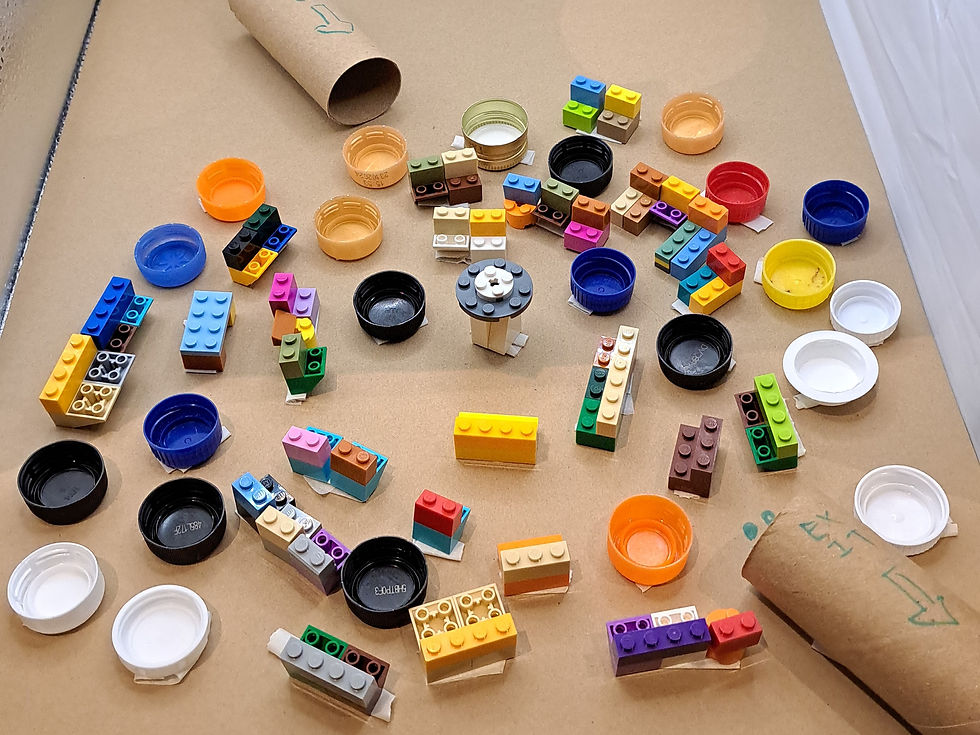
From the outset, we considered how children with different abilities and literacy levels could participate. Drawing, building, arranging materials, and acting out scenarios allowed ideas to surface that might never appear in a traditional discussion (Bonilla‑Sánchez et al., 2022; McFarland et al., 2025; Noonan et al., 2016).
Listening goes beyond noticing spoken language. When we broaden what counts as “voice,” we begin to see more children and hear them more fully.
This broader view also invites us to reflect on how we seek children’s opinions today. Often, this takes the form of online or paper surveys. While efficient, fixed questions and limited response options may not fully capture the richness and depth of children’s experiences. It is worth considering whether such formats truly allow children to express what they think and feel in their own ways.
Why It Matters
Children today grow up in a complex world. Inequality, climate change, and social divides shape their daily realities. For many children, the world can feel like a place where decisions are made without them. This sense of exclusion is even stronger for children growing up in vulnerable circumstances (OECD, 2019; Smith, 2015).
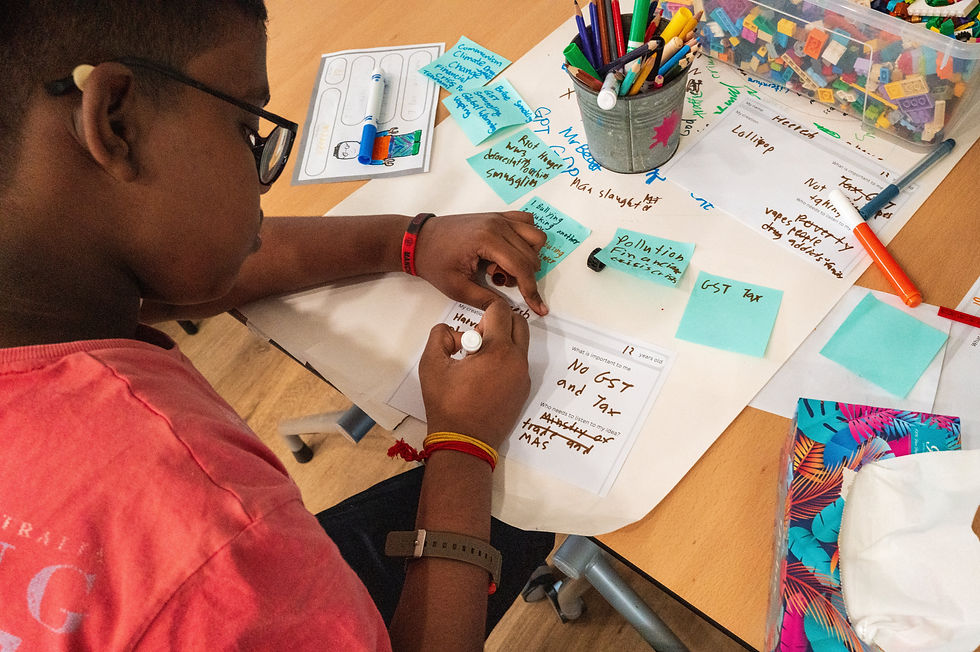
About 70% of the participating children come from vulnerable backgrounds. Beyond low-income households, they may live in families where relationships are strained or disrupted, where caregivers face stress, instability, or limited resources.
These conditions shape how children understand themselves and their place in the world. When daily life feels uncertain, it can quietly affect whether you believe your voice counts and whether you have any control over what happens around you.
Creating space for children to share what matters restores that sense of agency. It shows that their ideas can influence their surroundings and reframes them not as problems to be managed, but as partners with insight and lived wisdom.
In the KidsRights Index 2025, Singapore ranked 123 out of 194 countries in the domain of “Enabling Environment for Children’s Rights,” while placing within the top 15 in Life, Health, Education, and Protection (KidsRights Foundation and Erasmus University Rotterdam, 2025).
An enabling environment goes beyond protection and provision. It is about whether children feel heard, safe to speak up, and able to take part in decisions that affect them. It considers whether their views are taken seriously and they are given real opportunities to contribute.
Research shows that feeling valued and having value to add to the world predicts stronger mental health and greater civic engagement (Centre on the Developing Child, 2025). Children who experience this kind of recognition are more likely to extend it to others. When they know what it feels like to be listened to with respect, they will begin to practise that same respect in return.
What This Means for Adults
Many children spoke about the importance of family and expressed hope that parents and caregivers would truly listen.
If children’s voices matter, adults must make space for them, not just in workshops but in everyday life at the dinner table, on the walk home, and in moments of disagreement.
This begins with simple but intentional shifts.
It looks like adults slowing down and asking open questions, then waiting without interrupting. It means noticing body language, tone, and silence, not just words. It involves reflecting what we hear and creating spaces where children feel safe to disagree.
For many adults shaped by adultism, it also requires unlearning the instinct to control or correct “for their own good.”
What children need most is trust and time. Trust that their perspectives count, and time for adults to engage without immediately fixing or deciding. As Nur Hafizah from the Playeum team, who led the workshop, reflected:
“The children’s voices reflected the richness and layered realities of their lives and communities. It takes time to build trust, listen deeply, and make sense of diverse inputs, but it is this slower, more intentional way of working that leads to richer insights and more authentic outcomes.”
Valuing children’s voices does not mean they have the final say in every decision. It means their views are meaningfully considered (Shier, 2001; Hart, 1992).
Grant Tan, another facilitator, noted how adult roles must evolve in the digital age:
“There’s this whole idea that adults have to ‘teach’ children, ‘at the appropriate age,’ about the issues happening in the world. But with the internet and easy access to information, it’s less about teaching and more about helping children process what they see, both logically and emotionally, and understand that everyone can make an impact.
In our discussions, these children noticed inequities. So then, what can be done?”
Humility and openness are central to this work. It means acknowledging that we do not always have the answers, and sometimes no one does. It calls us to build environments grounded in relationships rather than rigid rules.
Do we listen to children simply to confirm what we already believe? Or are we willing to stay present when what we hear challenges us?
The invitation
At the start of the story, the children’s insistence on seeing the sky offers a quiet metaphor. To see the sky is to gain perspective, feel openness, and know that one’s environment allows room for possibility.
The question remains: if children tell us what matters to them, what will adults do next?
The deeper work lies in responding, ensuring that children’s contributions lead to real shifts in how spaces are designed, policies are shaped, and relationships are built.
Caring for children is not just about keeping them safe; it is about involving them.
For parents: Invite your child to make small everyday choices, like picking activities or meals. Encourage them to share their thoughts. Listen to understand rather than react.
For teachers: Design activities that let every child take part, using a variety of materials and mediums. Notice and discuss their ideas in class, and celebrate each child’s contributions.
For Institutions: Include children when making decisions that affect them. Ask them what they need when shaping programmes, public spaces, and policies.
Children are already opening up their world to us. The challenge, and invitation, is whether adults are ready to open ours in return.
Let’s show up for what matters for children, with children.
References
Bonilla‑Sánchez, M. D. R., García‑Flores, M. A., Méndez‑Balbuena, I. M., Silva‑González, J. G., & Ramírez‑Arroyo, E. V. (2022). The benefits of role play in the development of drawing in preschool children. Frontiers in Psychology, 13. https://www.frontiersin.org/journals/psychology/articles/10.3389/fpsyg.2022.1010512/full
Centre on the Developing Child. (2025). Mattering in early childhood: Building a strong foundation for life. Harvard University. https://developingchild.harvard.edu/wp-content/uploads/2025/10/Mattering-Paper-center-on-the-developing-child.pdf
Hart, R. (1992), Children’s Participation: From tokenism to citizenship (Rep. No. 4).
KidsRights Foundation & Erasmus University Rotterdam. (2025). The KidsRights Index 2025 Report. https://files.kidsrights.org/wp-content/uploads/2025/06/10223817/KidsRights-Index-2025-Report.pdf
McFarland, L., Page, J., Baker, L. M., Young, S., Caburnay, E. G., Levickis, P., & Eadie, P. (2025). “We need to keep picturing all of the stuff I like!”: Three‑year‑old children’s perspectives of their kindergarten experiences during educational reform. International Journal of Early Childhood. Advance online publication. https://link.springer.com/article/10.1007/s13158-025-00471-z
Noonan, R. J., Boddy, L. M., Fairclough, S. J., Knowles, Z. R., & Stratton, G. (2016). Write, draw, show and tell: A child‑centred dual methodology to explore perceptions of out‑of‑school physical activity. BMC Public Health, 16, Article 326. https://pubmed.ncbi.nlm.nih.gov/27080384/
OECD. (2019). Changing the odds for vulnerable children: Building opportunities and resilience. OECD Publishing. https://www.oecd.org/en/publications/changing-the-odds-for-vulnerable-children_a2e8796c-en.html
Shier, H. (2001), “Pathways to participation: openings, opportunities and obligations”, Children & Society, Vol. 15/2, pp. 107-117, https://www.researchgate.net/publication/233551300_Pathways_to_participation_Openings_opportunities_and_obligations
Smith, K. (2015). Childhood and youth citizenship. In J. Wyn & H. Cahill (Eds.), Handbook of Children and Youth Studies (pp. 357–376). Springer Singapore.


Comments